


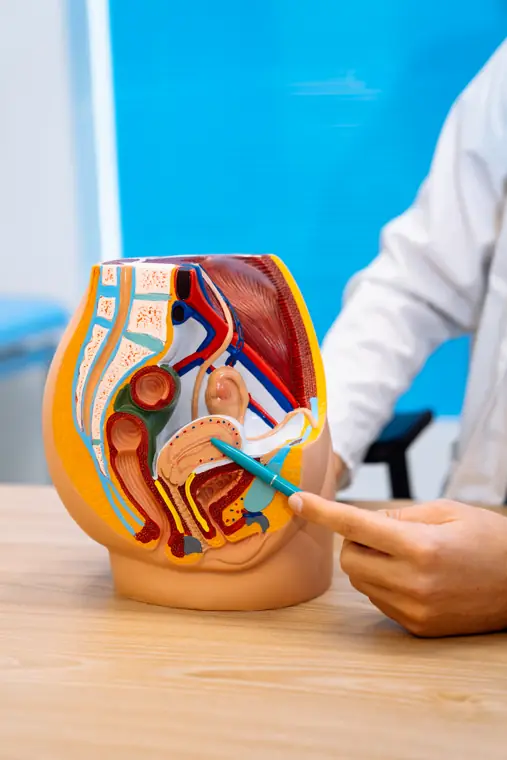
Urethral stricture is a narrowing of the urethra, the tube that carries urine out of the bladder, caused by scar tissue. For short strictures that appear for the first time, endoscopic methods can be tried. For long, recurrent or complex strictures, the treatment that gives longer-lasting results is surgical reconstruction of the urethra, known as urethroplasty. Strictures are more common in men but can also occur in women.
In urethral stricture, scar tissue forms on the inner lining of the urethra and narrows the passage for urine. The flow becomes weak and the bladder does not empty fully. Left untreated, it can lead to recurrent infections and to bladder and kidney problems. Because the choice of treatment depends on the position, length and cause of the stricture, much of the work starts with an accurate assessment.
Causes
- Previous urinary tract surgery, catheters or endoscopic procedures
- Injury to the groin and pelvis (falls, straddle injuries, road accidents)
- Urinary tract infections and sexually transmitted infections
- Skin conditions such as lichen sclerosus
- Strictures that develop after prostate surgery or radiotherapy
- In some patients, no clear cause is found
Symptoms
- A weak, split or dribbling urine stream
- Straining to pass urine, or urination that takes a long time
- A feeling that the bladder has not emptied fully, and needing to pass urine often
- Recurrent urinary tract infections
- Blood in the urine or a burning sensation
- In advanced cases, being unable to pass urine (retention)
How Is It Diagnosed?
After the examination, the urine flow rate is measured (uroflowmetry) and the amount of urine left in the bladder afterwards is checked. The position and length of the stricture are shown on a contrast X-ray of the urethra (retrograde urethrogram, and a voiding cystourethrogram if needed); in some patients the urethra is examined directly by urethroscopy. In women, urodynamic testing also contributes a great deal to the diagnosis. The treatment plan is then tailored to the individual on the basis of these findings.
Treatment Options
Endoscopic treatment (internal urethrotomy, dilatation)
For short strictures appearing for the first time, the narrowing can be cut open or widened with a camera passed through the urethra. No incision is needed, but the stricture may come back. Because repeated procedures can increase scar tissue, this is not the first choice for long or recurrent strictures.
Urethroplasty
In urethroplasty the narrowed section of the urethra is repaired surgically; this is the treatment that gives longer-lasting results in the long term. The technique is chosen according to the features of the stricture:
- End-to-end (anastomotic) urethroplasty: for short strictures, the narrowed section is removed and the healthy ends are joined together.
- Urethroplasty with a buccal mucosa graft: for long strictures, the urethra is widened using tissue taken from the inside of the cheek. The area inside the mouth heals quickly.
- Staged repair: for very long, complex strictures or those that have already been operated on several times, the repair may be planned in more than one stage.
Urethral Stricture in Women
Urethral stricture is less common in women than in men. Because its symptoms can be confused with bladder problems, diagnosis may be delayed. In women with a weak urine stream, incomplete emptying and recurrent infections, a stricture should also be considered. In suitable patients, female urethroplasty with a buccal mucosa graft can offer a more lasting solution than repeated dilatation. Assoc. Prof. Dr. Senad Kalkan worked with Prof. Dr. Jerry Blaivas at Mount Sinai in New York on female urology and urethral reconstruction.
After Surgery
After urethroplasty, a catheter stays in place until the repaired area has healed. How long it stays depends on the technique used; an X-ray check is usually done before it is removed. After discharge you will be asked to avoid heavy lifting and strenuous activity for a while. Regular follow-up visits and urine flow measurements are carried out to make sure the stricture has not come back.
Patients from Sarajevo and Abroad
Patients from Bosnia and Herzegovina and neighbouring countries seeking treatment for urethral stricture can have their initial assessment and follow-up appointments in Sarajevo. You can send your test results via WhatsApp for preliminary information.
Frequently asked questions
Which is better, urethroplasty or endoscopic treatment?
Does taking tissue from inside the mouth cause problems?
Can women have urethral stricture?
Can a urethral stricture come back?
What tests are done for urethral stricture?
When can I go back to work after urethral stricture surgery?
Last updated:
